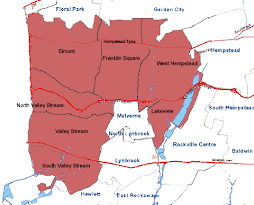
Two people were watching television in their North Valley Stream home on Friday night when they were suddenly confronted by two armed robbers.
A 68-year-man and a 13-year-old boy were in the basement of their Barry Drive West home when two other men burst in at about 8:15 p.m. on Aug. 26. The robbers, one armed with a handgun and the other with a knife, pointed their weapons at the homeowners and demanded money.
The robbers began looking through bags in the basement, taking an X-box and a cell phone. They then ordered the victims upstairs, before also taking a Play Station 3 and an iPad. The robbers then fled in an unknown direction.
No one was injured. The suspects are described as black males in their 30s, 6-foot, 180 pounds wearing hooded sweatshirts, blue jeans and bandanas concealing there faces.
Anyone with information is asked to call Crime Stoppers at (800) 244-TIPS. All callers will remain anonymous.
Wednesday, September 14, 2011


Tuesday, September 13, 2011
See Something Say Something
Nassau County Executive Edward P. Mangano and Acting Police Commissioner Tom Krumpter held a news conference today to discuss the state of heightened awareness here in Nassau County. As a direct result of the terror threat, the NCPD has stepped up its uniformed and plain clothes patrols, especially at our train stations and shopping malls.
“Our police department is a leader in the Secure Cities Program which coordinates all law enforcement in the Metro area,” said County Executive Mangano. “As the 10th Anniversary of the September 11th terrorist attack on our nation approaches, all should know that the Nassau County Police Department has been preparing to secure our County for many weeks.”
Residents can do their part by participating in the See Something, Say Something Campaign. For example: you know your neighbors, you know the vehicles that belong on your block and in your area, if you see something suspicious, say something! If you notice any individuals who appear suspicious, such as being overdressed for the weather or hiding something under their clothes, say something! If you see unattended packages or notice strange odors, say something! If you see someone suspicious drawing diagrams or maps, using binoculars, night vision devices or taking photographs and videos in unusual places, say something!
“I cannot stress this enough,” said County Executive Mangano. “Help us, help you. If you see something, say something by calling 911.”
“Our police department is a leader in the Secure Cities Program which coordinates all law enforcement in the Metro area,” said County Executive Mangano. “As the 10th Anniversary of the September 11th terrorist attack on our nation approaches, all should know that the Nassau County Police Department has been preparing to secure our County for many weeks.”
Residents can do their part by participating in the See Something, Say Something Campaign. For example: you know your neighbors, you know the vehicles that belong on your block and in your area, if you see something suspicious, say something! If you notice any individuals who appear suspicious, such as being overdressed for the weather or hiding something under their clothes, say something! If you see unattended packages or notice strange odors, say something! If you see someone suspicious drawing diagrams or maps, using binoculars, night vision devices or taking photographs and videos in unusual places, say something!
“I cannot stress this enough,” said County Executive Mangano. “Help us, help you. If you see something, say something by calling 911.”
Spraying Postponed
Dear Neighbors,
Please see the below statement issued by the county’s Department of Health and Department of Public Works. I will continue to keep you updated on this matter.
Best Regards,
Deputy Presiding Officer John J. Ciotti
Legislator, District 3
-------------------------------------------------------------------------------------------------
CONTACT: Mary Ellen Laurain 516.227.9455
Statement from the Nassau County Departments of Health and Public Works
Due to a no-fly zone imposed by the Federal Government, be advised that the aerial treatment for West Nile virus scheduled for Monday, Tuesday and Wednesday, September 12, 13 and 14 has been postponed.
Please see the below statement issued by the county’s Department of Health and Department of Public Works. I will continue to keep you updated on this matter.
Best Regards,
Deputy Presiding Officer John J. Ciotti
Legislator, District 3
-------------------------------------------------------------------------------------------------
CONTACT: Mary Ellen Laurain 516.227.9455
Statement from the Nassau County Departments of Health and Public Works
Due to a no-fly zone imposed by the Federal Government, be advised that the aerial treatment for West Nile virus scheduled for Monday, Tuesday and Wednesday, September 12, 13 and 14 has been postponed.
Saturday, September 10, 2011
Aerial Spraying for West Nile to Begin
Please be advised that the Department of Health will be conducting aerial sprayings for West Nile Virus beginning in the evening of Monday, September 12th, weather permitting. For more information, please read the following press release from the Department of Health.
Best Regards,
Deputy Presiding Officer John J. Ciotti
Legislator, District 3
Aerial Treatment For West Nile Virus to Begin
in Nassau County on Monday, Tuesday and Wednesday, September 12th, 13th and 14th
Uniondale, NY - Due to the high numbers of mosquitoes, presence of West Nile virus and large quantities of standing water following unprecedented rainfall, Nassau County Departments of Health and Public Works will enact additional mosquito control measures to protect the health of the public. These control measures include the aerial application of adulticide to eliminate viral activity and decrease the mosquito population within the County.
Where:
Areas to be Treated by Plane (See attached map)
Monday, September 12th : Zone 1
Nassau/Suffolk border to the Seaford Oyster Bay Expressway.
North of the Seaford-Oyster Bay Expressway at Jericho Turnpike.
Western Border: Route 106 beginning at Jericho Turnpike.
South of the Seaford-Oyster Bay Expressway at Merrick Road.
Western Border: Wantagh Parkway beginning at Merrick Road.
Zone 1 will also include the communities of Centre Island and the Barrier Islands (Tobay Beach, Jones Beach Point Lookout, Lido Beach, Long Beach and Atlantic Beach).
Alternate Date: Tuesday, September 13.
Tuesday, September 13th: Zone 2
Seaford Oyster Bay Expressway to the Meadowbrook Parkway.
North of the Meadowbrook Parkway at Glen Cove Road
Western Border: Glen Cove Road which changes names to Brewster Street, then School Street and ending along Dosoris Lane.
South of the Seaford-Oyster Bay Expressway at Merrick Road.
Eastern Border: Wantagh Parkway beginning at Merrick Road
North of the Seaford-Oyster Bay at Jericho Turnpike.
Eastern Border: Route 106 beginning at Jericho Turnpike.
Alternate Date: Wednesday, September 14.
Wednesday, September 14th : Zone 3
From the Nassau/Queens border to Meadowbrook Parkway
North of the Meadowbrook Parkway at Glen Cove Road.
Eastern Border: Glen Cove Road which changes names to Brewster Street, then School Street and ending along Dosoris Lane
Alternate Date: Thursday, September 15.
Weather permitting, the planned schedule for aerial treatment will be on Monday, September 12 beginning at 7 P.M. and ending at 1 A.M., Tuesday, September 13 beginning at 7 P.M. and ending at 1 A.M and Wednesday, September 14, beginning at 7 P.M. and ending at 1 A.M.
What: Scourge is a pesticide containing resmethrin and piperonyl butoxide. Resmethrin is a man-made pyrethroid insecticide that can also be found in other pesticide products used indoors and on pets to control ticks and other insects, such as fleas and ants. Piperonyl butoxide does not directly kill insects on its own, but acts to increase the ability of resmethrin to kill insects. These active ingredients are dissolved in a petroleum solvent.
Health Effects: The chance of experiencing any health effects from the use of Scourge to control mosquitoes is quite low. As with any pesticide, individuals may want to reduce or eliminate exposure. Some particularly sensitive individuals may possibly experience short-term effects such as eye, skin, nose or throat irritation or breathing problems.
To Reduce Exposure: The US Environmental Protection Agency (EPA) and the New York State Department of Environmental Conservation (DEC) do not require relocating or taking special precautions during mosquito control treatment. Individuals, especially pregnant women and children, should remain inside during the treatment and for about 30 minutes afterwards. In addition, individuals may minimize exposure by:
Keeping windows and doors shut, setting air conditioners to re-circulate if able. Turn window fans off.
Keeping children's toys indoors.
Keeping pets indoors, as well as their food, water dishes and toys.
Covering fishponds during the spray period.
Since the effects of the aerial treatment dissipate in a few hours, it is not necessary to wash off outdoor furniture or playground equipment before use, although doing so will not diminish the effectiveness of the pesticide applied.
For additional information: Please call the West Nile Virus Spray Hotline at 1-888-844-8657, on the days that spraying is scheduled, between the hours of 9:00 AM and 1:00 AM or visit the Nassau County Department of Health website at http://www.nassaucountyny.gov/agencies/Health/index.html or the Nassau County website at www.nassaucountyny.gov/
Best Regards,
Deputy Presiding Officer John J. Ciotti
Legislator, District 3
Aerial Treatment For West Nile Virus to Begin
in Nassau County on Monday, Tuesday and Wednesday, September 12th, 13th and 14th
Uniondale, NY - Due to the high numbers of mosquitoes, presence of West Nile virus and large quantities of standing water following unprecedented rainfall, Nassau County Departments of Health and Public Works will enact additional mosquito control measures to protect the health of the public. These control measures include the aerial application of adulticide to eliminate viral activity and decrease the mosquito population within the County.
Where:
Areas to be Treated by Plane (See attached map)
Monday, September 12th : Zone 1
Nassau/Suffolk border to the Seaford Oyster Bay Expressway.
North of the Seaford-Oyster Bay Expressway at Jericho Turnpike.
Western Border: Route 106 beginning at Jericho Turnpike.
South of the Seaford-Oyster Bay Expressway at Merrick Road.
Western Border: Wantagh Parkway beginning at Merrick Road.
Zone 1 will also include the communities of Centre Island and the Barrier Islands (Tobay Beach, Jones Beach Point Lookout, Lido Beach, Long Beach and Atlantic Beach).
Alternate Date: Tuesday, September 13.
Tuesday, September 13th: Zone 2
Seaford Oyster Bay Expressway to the Meadowbrook Parkway.
North of the Meadowbrook Parkway at Glen Cove Road
Western Border: Glen Cove Road which changes names to Brewster Street, then School Street and ending along Dosoris Lane.
South of the Seaford-Oyster Bay Expressway at Merrick Road.
Eastern Border: Wantagh Parkway beginning at Merrick Road
North of the Seaford-Oyster Bay at Jericho Turnpike.
Eastern Border: Route 106 beginning at Jericho Turnpike.
Alternate Date: Wednesday, September 14.
Wednesday, September 14th : Zone 3
From the Nassau/Queens border to Meadowbrook Parkway
North of the Meadowbrook Parkway at Glen Cove Road.
Eastern Border: Glen Cove Road which changes names to Brewster Street, then School Street and ending along Dosoris Lane
Alternate Date: Thursday, September 15.
Weather permitting, the planned schedule for aerial treatment will be on Monday, September 12 beginning at 7 P.M. and ending at 1 A.M., Tuesday, September 13 beginning at 7 P.M. and ending at 1 A.M and Wednesday, September 14, beginning at 7 P.M. and ending at 1 A.M.
What: Scourge is a pesticide containing resmethrin and piperonyl butoxide. Resmethrin is a man-made pyrethroid insecticide that can also be found in other pesticide products used indoors and on pets to control ticks and other insects, such as fleas and ants. Piperonyl butoxide does not directly kill insects on its own, but acts to increase the ability of resmethrin to kill insects. These active ingredients are dissolved in a petroleum solvent.
Health Effects: The chance of experiencing any health effects from the use of Scourge to control mosquitoes is quite low. As with any pesticide, individuals may want to reduce or eliminate exposure. Some particularly sensitive individuals may possibly experience short-term effects such as eye, skin, nose or throat irritation or breathing problems.
To Reduce Exposure: The US Environmental Protection Agency (EPA) and the New York State Department of Environmental Conservation (DEC) do not require relocating or taking special precautions during mosquito control treatment. Individuals, especially pregnant women and children, should remain inside during the treatment and for about 30 minutes afterwards. In addition, individuals may minimize exposure by:
Keeping windows and doors shut, setting air conditioners to re-circulate if able. Turn window fans off.
Keeping children's toys indoors.
Keeping pets indoors, as well as their food, water dishes and toys.
Covering fishponds during the spray period.
Since the effects of the aerial treatment dissipate in a few hours, it is not necessary to wash off outdoor furniture or playground equipment before use, although doing so will not diminish the effectiveness of the pesticide applied.
For additional information: Please call the West Nile Virus Spray Hotline at 1-888-844-8657, on the days that spraying is scheduled, between the hours of 9:00 AM and 1:00 AM or visit the Nassau County Department of Health website at http://www.nassaucountyny.gov/agencies/Health/index.html or the Nassau County website at www.nassaucountyny.gov/
Thursday, September 8, 2011
Counterfeit Lottery Scams
County Executive Edward P. Mangano and Acting Police Commissioner Thomas C. Krumpter are urging citizens to be vigilant when receiving unexpected mailings or other forms of solicitations that inform them that they are winners of a lottery, especially if the correspondence is from a foreign country.
It has come to the attention of the Nassau County Police Department that individuals are receiving phone calls and notifications in the mail that they are winners of a sweepstakes lottery and in some instances they receive a partial bank check of the winnings that appears to be legitimate.
These lotteries are scams that cost honest citizens thousands of unrecoverable dollars. Remember, “If you did not buy a lottery ticket, you cannot win a lottery.” “If you receive a check for a lottery you did not enter, it is counterfeit.”
There are No Exceptions.
The following tips are being offered in the event you are sent one of these counterfeit lottery notifications:
· Don’t send money if a caller requires you send money “right now!” and that you must wire money before you can claim your prize.
· Don’t wire money to someone you don’t know well. After your money is paid, you will not get it back.
· Don’t send money to someone who tells you what to say to the wire transfer agent, or says you should hide information or lie to the agent.
· No legitimate bank or credit card company will ask you to supply them with your social security number or bank account passwords over the telephone or on-line.
· Contact your local police department if you receive one of these counterfeit lottery notifications.
It has come to the attention of the Nassau County Police Department that individuals are receiving phone calls and notifications in the mail that they are winners of a sweepstakes lottery and in some instances they receive a partial bank check of the winnings that appears to be legitimate.
These lotteries are scams that cost honest citizens thousands of unrecoverable dollars. Remember, “If you did not buy a lottery ticket, you cannot win a lottery.” “If you receive a check for a lottery you did not enter, it is counterfeit.”
There are No Exceptions.
The following tips are being offered in the event you are sent one of these counterfeit lottery notifications:
· Don’t send money if a caller requires you send money “right now!” and that you must wire money before you can claim your prize.
· Don’t wire money to someone you don’t know well. After your money is paid, you will not get it back.
· Don’t send money to someone who tells you what to say to the wire transfer agent, or says you should hide information or lie to the agent.
· No legitimate bank or credit card company will ask you to supply them with your social security number or bank account passwords over the telephone or on-line.
· Contact your local police department if you receive one of these counterfeit lottery notifications.
School Bus Safety Tips
It’s back to school time and Nassau County Executive Edward P. Mangano and Acting Police Commissioner Thomas C. Krumpter would like to issue some school bus safety tips for students and motorists.
Some facts about school bus safety are as follows:
· The most dangerous part of the school bus ride is getting on and off the school bus.
· Pedestrian fatalities (while loading and unloading school buses) account for approximately three times as many school bus-related fatalities, when compared to school bus occupant fatalities.
· The loading and unloading area is called the "Danger Zone".
· The "Danger Zone" is the area on all sides of the bus where children are in the most danger of not being seen by the driver (ten feet in front of the bus where the driver may be too high to see a child, ten feet on either side of the bus where a child may be in the driver's blind spot, and the area behind the school bus).
· More than half of the pedestrian fatalities in school bus-related crashes are children between 5 and 7 years old in 1999.
Young children are most likely to be struck because they:
Hurry to get on and off the bus
· Act before they think and have little experience with traffic
· Assume motorists will see them and will wait for them to cross the street
· Don't always stay within the bus driver's sight
· Studies have shown that many drivers illegally pass stopped school buses that are loading/unloading students.
Students riding a school bus should always:
Arrive at the bus stop five minutes early.
· Stand at least 5 giant steps (10 feet) away from the edge of the road.
· Wait until the bus stops, the door opens, and the driver says its okay before stepping onto the bus.
· Be careful that clothing with drawstrings and book bags with straps or dangling objects do not get caught in the handrail or door when exiting the bus.
· Walk in front of the bus; never walk behind the bus.
· Walk on the sidewalk or along the side of the road to a point at least five giant steps (10 feet) ahead.
· Be sure the bus driver can see you, and you can see the bus driver.
· Stop at the edge of the bus and look left-right-left before crossing.
· Tell the bus driver if you drop something beside the bus. Should you try to pick it up, the bus driver may not see you and drive into you.
During the school bus ride:
· Always sit fully in the seat and face forward
· DO NOT distract the driver
· Never stand on a moving bus
· Obey the driver
· Speak in a low voice
· NEVER stick anything out the window -- arms, legs, head, book bags, etc.
Motorists Should:
· Be aware it is illegal in every state to pass a school bus stopped to load/unload students.
Know and understand laws governing motorist's driving behavior near a school bus.
Learn the "flashing signal light system" that school bus drivers use to alert motorists if they are going to stop to load/unload students.
Yellow flashing lights indicate the bus is preparing to stop to load or unload children.
Motorists should slow down and prepare to stop their vehicles.
Red flashing lights and extended stop arms indicate that the bus has
stopped, and that children are getting on or off. Motorists MUST stop their cars.
· Begin moving only when the red flashing lights are turned off, the stop arm is withdrawn and the bus begins to move.
· Watch out for young people who may be thinking about getting to school, but may not be thinking about getting there safely.
· Slow Down. Watch for children walking in the street, especially if there are no sidewalks in the neighborhood. Watch for children playing and gathering near bus stops.
· Be Alert. Children arriving late for the bus may dart into the street without looking for traffic.
Some facts about school bus safety are as follows:
· The most dangerous part of the school bus ride is getting on and off the school bus.
· Pedestrian fatalities (while loading and unloading school buses) account for approximately three times as many school bus-related fatalities, when compared to school bus occupant fatalities.
· The loading and unloading area is called the "Danger Zone".
· The "Danger Zone" is the area on all sides of the bus where children are in the most danger of not being seen by the driver (ten feet in front of the bus where the driver may be too high to see a child, ten feet on either side of the bus where a child may be in the driver's blind spot, and the area behind the school bus).
· More than half of the pedestrian fatalities in school bus-related crashes are children between 5 and 7 years old in 1999.
Young children are most likely to be struck because they:
Hurry to get on and off the bus
· Act before they think and have little experience with traffic
· Assume motorists will see them and will wait for them to cross the street
· Don't always stay within the bus driver's sight
· Studies have shown that many drivers illegally pass stopped school buses that are loading/unloading students.
Students riding a school bus should always:
Arrive at the bus stop five minutes early.
· Stand at least 5 giant steps (10 feet) away from the edge of the road.
· Wait until the bus stops, the door opens, and the driver says its okay before stepping onto the bus.
· Be careful that clothing with drawstrings and book bags with straps or dangling objects do not get caught in the handrail or door when exiting the bus.
· Walk in front of the bus; never walk behind the bus.
· Walk on the sidewalk or along the side of the road to a point at least five giant steps (10 feet) ahead.
· Be sure the bus driver can see you, and you can see the bus driver.
· Stop at the edge of the bus and look left-right-left before crossing.
· Tell the bus driver if you drop something beside the bus. Should you try to pick it up, the bus driver may not see you and drive into you.
During the school bus ride:
· Always sit fully in the seat and face forward
· DO NOT distract the driver
· Never stand on a moving bus
· Obey the driver
· Speak in a low voice
· NEVER stick anything out the window -- arms, legs, head, book bags, etc.
Motorists Should:
· Be aware it is illegal in every state to pass a school bus stopped to load/unload students.
Know and understand laws governing motorist's driving behavior near a school bus.
Learn the "flashing signal light system" that school bus drivers use to alert motorists if they are going to stop to load/unload students.
Yellow flashing lights indicate the bus is preparing to stop to load or unload children.
Motorists should slow down and prepare to stop their vehicles.
Red flashing lights and extended stop arms indicate that the bus has
stopped, and that children are getting on or off. Motorists MUST stop their cars.
· Begin moving only when the red flashing lights are turned off, the stop arm is withdrawn and the bus begins to move.
· Watch out for young people who may be thinking about getting to school, but may not be thinking about getting there safely.
· Slow Down. Watch for children walking in the street, especially if there are no sidewalks in the neighborhood. Watch for children playing and gathering near bus stops.
· Be Alert. Children arriving late for the bus may dart into the street without looking for traffic.
Thursday, September 1, 2011
Follow up from Nassau County Fire Marshall
1. Never run a portable generator or portable pump inside your home, garage, or any enclosed area. Generators and Portable Pumps when running, produce deadly Carbon Monoxide. Keep running generators and portable pumps away from doorways, windows, and other building openings.
2. Never use a BBQ, Hibachi, or Portable Grill inside your home, garage, or in any enclosed space. Besides being a Fire Hazard, they produce deadly Carbon Monoxide. Both Propane and Charcoal grills produce Carbon Monoxide when in use. Cook in a well ventilated area away from your home.
3. Avoid the use of Candles for illumination during times of power outage. Candles have been responsible for several fires in Nassau County during Hurricane Irene. Open flame candle fires spread quickly, and can be deadly. Use "battery operated" flashlights and lanterns instead.
4. Never touch or go near downed power lines, or "any" metal objects near them such as fences. Approaching such areas can be deadly.
5. With extended power outage, Fire & Smoke Detection Systems in your home may no longer be operational. Be vigilant about fire safety in your home during this period. Purchase and install "battery operated" Smoke and Carbon Monoxide Detectors, and utilize them until power is restored and you are certain that your system in operational and in good working order.
6. If using power tools such as chain saws, etc. use them with "Great Care" and only if completely familiar with their operation, use, and manufacturers guidelines. Wear proper protective equipment when working with or around power tools (gloves, eye & ear protection).
7. Residents are urged to save 9-1-1 for "life threatening" emergencies only. Keeping these lines free may save a life.
The Nassau County "non emergency" and "information" line for Hurricane Irene questions and issues is 1-888-684-4274.
2. Never use a BBQ, Hibachi, or Portable Grill inside your home, garage, or in any enclosed space. Besides being a Fire Hazard, they produce deadly Carbon Monoxide. Both Propane and Charcoal grills produce Carbon Monoxide when in use. Cook in a well ventilated area away from your home.
3. Avoid the use of Candles for illumination during times of power outage. Candles have been responsible for several fires in Nassau County during Hurricane Irene. Open flame candle fires spread quickly, and can be deadly. Use "battery operated" flashlights and lanterns instead.
4. Never touch or go near downed power lines, or "any" metal objects near them such as fences. Approaching such areas can be deadly.
5. With extended power outage, Fire & Smoke Detection Systems in your home may no longer be operational. Be vigilant about fire safety in your home during this period. Purchase and install "battery operated" Smoke and Carbon Monoxide Detectors, and utilize them until power is restored and you are certain that your system in operational and in good working order.
6. If using power tools such as chain saws, etc. use them with "Great Care" and only if completely familiar with their operation, use, and manufacturers guidelines. Wear proper protective equipment when working with or around power tools (gloves, eye & ear protection).
7. Residents are urged to save 9-1-1 for "life threatening" emergencies only. Keeping these lines free may save a life.
The Nassau County "non emergency" and "information" line for Hurricane Irene questions and issues is 1-888-684-4274.
Subscribe to:
Posts (Atom)